
Skip to content
New Concept Auto Service Honest · Accurate · New Concept
Mon–Fri · 7:30am–5:30pm 5 Johnson County Shops
№ 01
Suspension Repair

Suspension Repair

Expert Suspension Repair in Overland Park, South Overland Park, Merriam, Shawnee & Olathe, KS.

Book Service
ASE-Certified Technicians5-Yr / 50k-Mile WarrantyHonest, Photo-Documented EstimatesAAA Approved
OverviewFig. 02

Your suspension is why a rough road still feels controlled — and why worn parts show up first as sloppy handling long before anything breaks.

Suspension wears in slowly. One day the car floats a little over bumps, dives harder under braking, or feels less planted on the highway — and because it happens over months, most drivers adapt to it without realizing how much grip and composure they've lost. By the time a shock is leaking or a joint is clunking, the handling has usually been degrading for a while.

At New Concept, a suspension check isn't a glance — it's a hands-on inspection of the dampers, joints, bushings, and bearings that keep your tires in firm contact with the road. You get a straight read on what's actually worn versus what still has life, so you're fixing the part that's causing the problem, not a guess.

Symptom Explorer

Signs your suspension needs attention

Suspension problems usually show up as a change in how the car rides, handles, or sounds. Match what you're noticing to the signs below — each points to a likely cause that a professional inspection can confirm.

A note on symptoms — These signs point to likely causes, not a definitive diagnosis. A hands-on inspection is the only way to confirm which component is worn.

When the car keeps bobbing after a dip or railroad crossing instead of settling in one motion, the shocks or struts have usually lost their damping ability. Worn dampers let the springs oscillate, which hurts both comfort and tire grip. A quick bounce test and a look for fluid leaks usually tells the story.

A clunk from a corner when you hit a pothole or driveway lip often traces to a worn ball joint, control-arm bushing, sway-bar link, or a strut mount. Because several parts can make a similar noise, we locate it by inspecting and loading each joint rather than guessing.

Excessive nose-dive under braking, or the tail squatting under acceleration, usually means the shocks or struts aren't controlling weight transfer the way they should. Beyond the unsettled feel, this shifts load off the rear tires and can lengthen stops, so it's worth checking.

Worn dampers let the tire bounce against the road instead of rolling smoothly, which can leave a scalloped, cupped pattern across the tread. Loose joints can also create uneven wear by letting alignment angles drift. We inspect the suspension and the wear pattern together to find the root cause.

If the steering feels vague and you're making constant small corrections to hold a lane, worn bushings, ball joints, or wheel bearings may be letting the geometry move around under load. It's a control and fatigue issue, not just a comfort one, and it tends to worsen gradually.

A droning noise that rises with speed — and sometimes changes when you sway the car gently side to side — can indicate a failing wheel bearing. Bearings can wear quietly for a while, so catching it early keeps a simple part from turning into a bigger repair.

How It WorksComponent Explorer

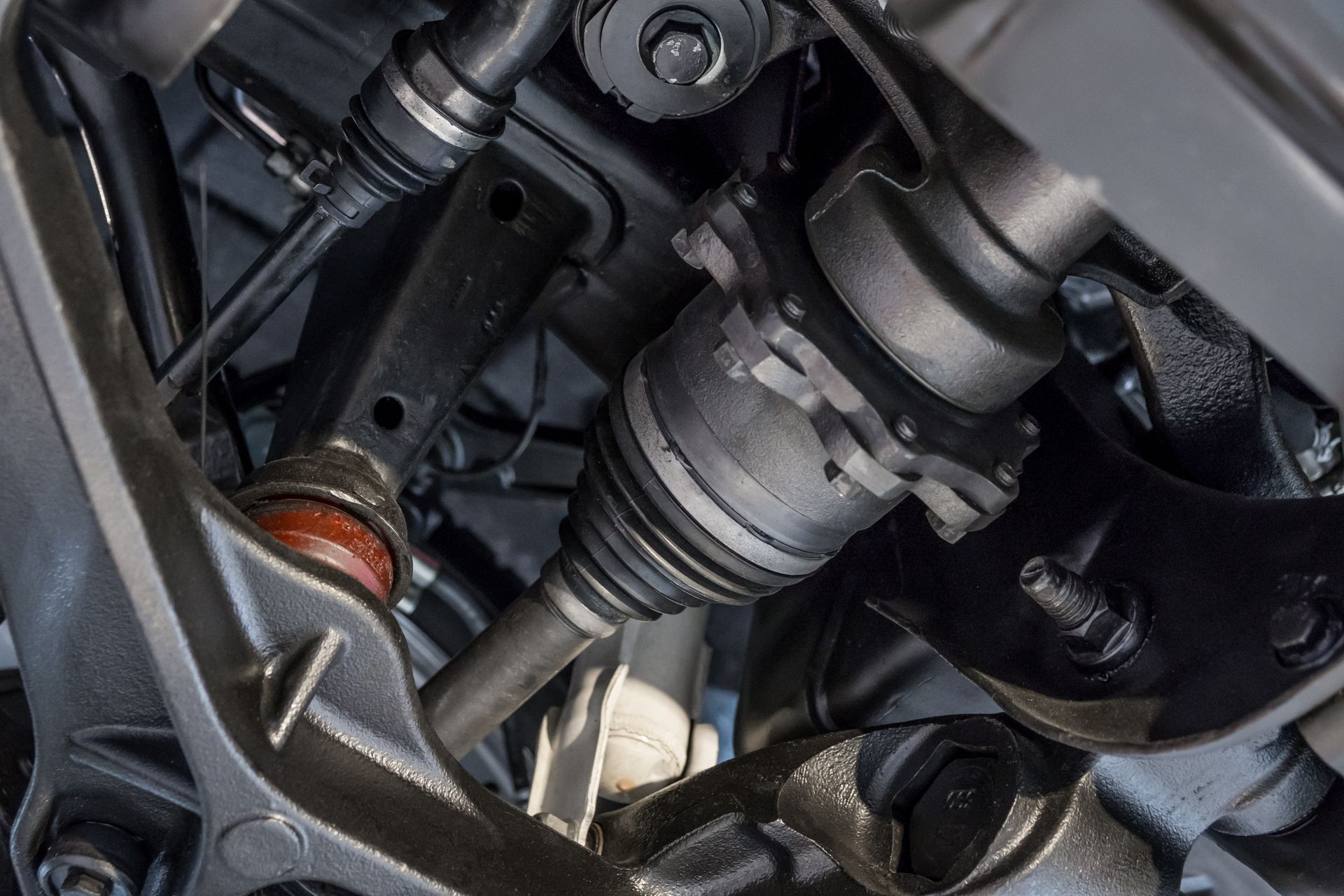
The parts that keep you planted

01

Shock absorbers

Dampers that control the motion of the springs so the car settles after a bump instead of bouncing. As they wear, ride comfort and tire grip both drop — often so gradually that drivers don't notice until new ones go on. They're measured by condition and leakage, not just mileage.

02

Struts

A combined shock absorber and structural support used on many vehicles, often carrying the spring and part of the steering geometry. Because a strut is tied into alignment, replacing one usually calls for an alignment check afterward. Worn struts show up as poor ride control and can affect tire wear.

03

Control arms & bushings

The arms that connect the wheel assembly to the frame and let it move up and down in a controlled arc. The rubber bushings at their pivots quiet the ride and hold alignment; when they crack or soften, you get clunks, looseness, and drifting alignment angles.

04

Ball joints

Pivot joints that let the wheels steer and move with the suspension at the same time. They carry real load and wear over time; a loose ball joint causes clunking, uneven tire wear, and vague steering. Because they're load-bearing, a worn one is a safety item worth addressing.

05

Sway bar & links

The sway (stabilizer) bar ties the left and right sides together to limit body roll in corners, connected by small links and bushings. Worn links are a common source of a rattling clunk over bumps and can let the body lean more than it should in turns.

06

Wheel bearings

The bearings that let each wheel spin smoothly on its hub while carrying the vehicle's weight. A failing bearing typically hums or growls with speed and can develop play you can feel. Left alone, a bad bearing can affect ABS sensors and, eventually, safe wheel operation.

What's Included№ 05 — Scope of Work

Suspension repairs we handle

From a single worn damper to a full front-end refresh, our suspension work covers the parts that control your ride, handling, and stability.

01

Shock absorber replacement

Replacing worn or leaking shocks to restore ride control and keep the tires in firm contact with the road.

Repair details
02

Strut replacement

Replacing worn strut assemblies, with an alignment check afterward since struts tie into the steering geometry.

Repair details
03

Control arm & bushing replacement

Replacing control arms or pressing in fresh bushings when cracked rubber lets the wheel move out of position.

04

Ball joint replacement

Replacing worn load-bearing ball joints that cause clunking, uneven tire wear, or loose steering.

05

Sway bar link & bushing service

Replacing rattling stabilizer-bar links and bushings to firm up body control and quiet the ride.

06

Wheel bearing replacement

Replacing bearings that hum, growl, or develop play before they affect ABS or wheel operation.

Repair details
07

Coil & leaf spring service

Inspecting and replacing sagging, broken, or corroded springs that change ride height and handling.

08

Strut mount & bearing replacement

Replacing the upper mounts and bearings that can cause clunking or binding in the steering.

09

Complete front-end inspection

A full hands-on check of joints, bushings, bearings, and dampers to pinpoint the real source of a noise or handling complaint.

Why Diagnostics Matter

Found by inspection, not by parts-swapping

A clunk over bumps can be a ball joint, a sway-bar link, a tired bushing, or a strut mount — and each one is a different repair. Throwing parts at the noise is an expensive way to find out which it was, and it leaves the real culprit in place. The honest path is to load and inspect each joint and find the one that's actually moving.

We check the dampers for leakage and control, work each joint and bushing by hand, listen for bearing noise, and look at your tire-wear pattern for clues the parts alone won't give. That's how a suspension estimate reflects what your vehicle needs rather than a standard package.

  • 01Each joint & bushing loaded and inspected by hand
  • 02Dampers checked for leakage and ride control
  • 03Wheel bearings checked for noise and play
  • 04Tire-wear pattern read for the root cause
When To Come In№ 07

When to have your suspension checked

Suspension rarely fails all at once — it degrades. These are the moments worth a look.

Watch for
  • Bouncing, floating, or a harsh, unsettled ride
  • Clunking or knocking over bumps
  • Cupped or uneven tire wear
  • The car wandering or feeling loose on the highway
If you wait
  • Worn dampers reduce tire grip and lengthen stops
  • A loose joint can accelerate uneven tire wear
  • Neglected bushings let alignment angles drift
  • Small worn parts can overload neighboring components
Stay ahead
  • Have the suspension inspected at each tire rotation
  • Replace dampers in pairs so handling stays balanced
  • Address clunks early, before they wear related parts
  • Pair strut or control-arm work with an alignment check
Safety first
  • Worn suspension affects control in an emergency maneuver
  • A failing wheel bearing can affect safe wheel operation
  • Load-bearing ball joints are a safety item, not just comfort
  • A second opinion on any front-end estimate is always free here
The Process

What to expect, start to finish

The same disciplined workflow on every job — so you always know what's happening and why.

  1. 01

    Initial inspection

    We start by listening to how the vehicle is behaving, then put it on the lift for a hands-on look at the system you came in for.

  2. 02

    Diagnostic testing

    Where a fault is electronic or intermittent, we scan control modules and test live data instead of guessing at parts.

  3. 03

    Findings & explanation

    You get a plain-language rundown of what we found — often with photos — so the problem is clear before any work is quoted.

  4. 04

    Repair recommendations

    We separate what needs attention now from what can safely wait, with an honest written estimate.

  5. 05

    Your authorization

    Nothing happens until you approve it. No surprise add-ons, no pressure.

  6. 06

    Professional repair

    ASE-certified technicians complete the work with quality parts, torqued and fitted to spec.

  7. 07

    Quality verification

    We re-test and road-check the repair, then hand the vehicle back backed by our nationwide warranty.

QuestionsFAQ

Frequently asked questions

It comes down to what's actually worn, which is why we inspect rather than assume. A bouncy, floaty ride points toward tired shocks or struts, while a clunk over bumps usually means a joint, link, or bushing. We load each part by hand and check the dampers for leaks so the recommendation matches the real problem.
It's the usual recommendation because dampers wear with use, so a side that's seen the same miles is likely close behind. Replacing them in pairs keeps the car balanced side to side, which matters for even braking and predictable handling. We'll always show you what we measured and let you decide.
Some suspension parts — struts, control arms, tie rods — directly set the angles your tires sit at. When those parts are replaced, the alignment can shift, so checking and correcting it protects your new parts and your tires. We'll tell you up front when a repair calls for an alignment afterward.
Yes. Worn dampers let the tire bounce and scuff instead of rolling smoothly, and loose joints or bushings let alignment angles drift, both of which show up as uneven tread wear. That's why we read the wear pattern as part of the inspection — the tires often point to the underlying cause.
It depends entirely on what's clunking, which is why it's worth an inspection rather than a wait-and-see. A rattling sway-bar link is mostly a comfort issue, but a worn ball joint or strut mount is load-bearing and should be addressed. We'll tell you honestly whether it can wait or should be handled now.
Find A LocationFive Johnson County shops

Service near you

Book at the New Concept shop that's most convenient — same ASE-certified standards and nationwide warranty at every location.

01

Overland Park

9573 W 87th St, Overland Park, KS 66212
02

Merriam

6032 Merriam Dr, Merriam, KS 66203
03

Shawnee

4119 Bonner Industrial Dr, Shawnee, KS 66226
04

Olathe

128 N Mahaffie St, Olathe, KS 66061
05

South Overland Park

7601 W 119th St, Overland Park, KS 66213
Book an Appointment

Ready when you are.

Book online in under a minute, or call and talk to a real person. Honest estimates, no pressure — your dealership alternative in Johnson County.